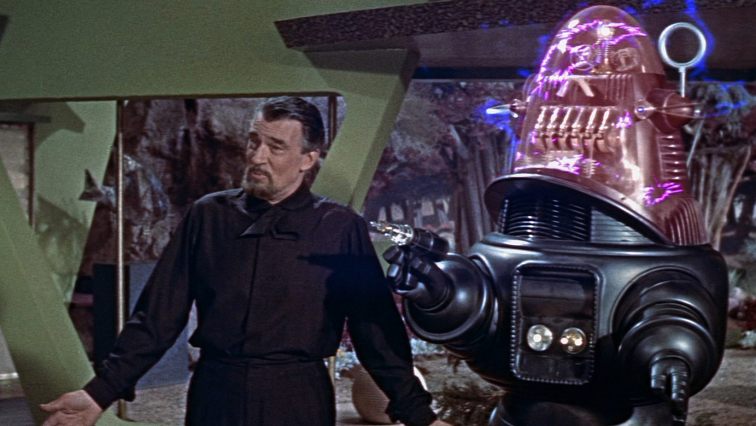
I was reminded of this movie after watching a video I had posted earlier this week. It’s a film I’d watched dozens of times over the years before realizing how far ahead of its time it was. I can’t say why it took me so long to understand how groundbreaking it truly was. Maybe it’s a question of the special effects? I’d already been spoiled by more advanced film technology by the time I watched it. The effects may have been mindbending in 1956 but by the 70s, having seen 2001 and other cinematic juggernauts it just seemed dated. The acting and dialogue and costumes were anachronistic by then. The plot was lost on me but that was most likely my own lack of sophistication.
The onslaught of technological advances were taken for granted and kind of lost on me. People were walking on the moon, in reality. There were wonders in the moment that eclipsed 50s films. I was too busy… wondering. I took for granted that we would have communities in space. There would be jetpacks, flying cars, and machines that could create anything we could imagine and program (almost there maybe with 3-D printing and gene-splicing and stem cell technology?). There was nothing to be feared if you looked at it from the mind of a 12 year old, and I carried my 12 year old mind well into my 20s.
It was only later that I began to understand the fear of technology reflected in films was actually a reflection of our own fear of where it would all lead us. There is still a very tangible fear of what we will lose collectively (we, the human race.) My consciousness of it started with articles in the 70s of how robots would replace humans in factories and mills and mines. Then the talk began of artificial intelligence. Where would our place in the world/universal order be if we actually created superior beings? Nevermind that we may not even be smart enough to create beings smarter than us. Are we even capable of imagining just what “smarter” looks like? Thinking faster certainly, as it’s already been done. But where from there? If robots can replace us in manual labor (and enter a new subtext of the slavery argument here), where else can they render us obsolete? My pre-caffeinated brain can’t even do this topic justice at the moment, but the fears are here. I worked for nearly three years at The Economist on conferences examining many of these very subjects. Will A.I, for example, eliminate jobs for humans, or create more?There is no consensus on that and the arguments are pretty heated and bitter.
When the A.I. discussions began way back when, there were lofty thinkers that proclaimed that once humans were freed from labor by robots and A.I. then we could spend all our time in higher pursuits, like the arts, philosophy and ending disease and hunger. We were to enter an age of pacifism and love and blah blah blah.
Which brings us back to why Forbidden Planet was ahead of its time for a film. The Krell, the extinct alien race in FP, had supposedly reached that level of advanced science and technology. only to find themselves alienated from the elements of their being that made them sapient and sentient. When some of these baser elements manifested through their technology, they were so far removed from their humanity that they didn’t even recognize what was plaguing them, these “monsters of the Id,” as they were described by one character. The machine… the super-computer that the Krell had built was able to create anything the Krell could imagine simply by reading their thoughts. It began to dig down deeper though and read their sub-conscious minds and the monsters were born. They manifested the emotions and the insecurities, the fear, the jealousy, the lust, the hatred, and all the parts of their being that the Krell had repressed while they built their technological Utopia. Doctor Morbius, who had been stranded on the planet with this daughter for years, had so idealized the Krell’s vision that even he didn’t see what was happening until it was too late to save himself. He knew just enough to see that it was far too advanced to allow the new arrivals on the planet to bring it back to Earth to share it. He knew the human race wasn’t ready, but he didn’t fully see why until right before it killed him.
I had previously thought that the Terminator series was the apex of the man vs. machine genre, but that was before I had re-considered Forbidden Planet, which as it turns out had an even more intelligent take on the argument. With Terminator and its sequels, Skynet had become man’s undoing. We built a superior “being” and in the classic sense of the discussion, the machine no longer needed us to exist. This was less so with The Matrix, but again, it was a superior “being” that subjugated the human race. It was the classic man vs. machine battle.
Forbidden Planet was a lot more profound. It never came down to man vs. machine. It was humanity vs. humanity. The alien power wasn’t technology. It was the products of our inner minds that we’d become alienated from. It was all the aspects of our own humanity that we are still, as individuals and as a race, often alienated from. That is what was what brought on the extinction of The Krell, who were so much more advanced than us and even they remained vulnerable. It was never the technology that they needed to fear and if they’d spent more time examining what made them tick, or what motivated them, then they’d have designed their machine differently.
The message of Forbidden Planet? Perhaps that we’re not ready for the products of our limitless imagination, because we’re still in the infancy of our understanding of ourselves. There is the final quote from the movie though and it’s more thought-provoking than a concise wrap-up of the message of the movie: “About a million years from now the human race would have crawled up to where the Krell stood in their great moment of triumph and tragedy. And your fathers name will shine again like a beacon in galaxy. It’s true It will remind us that we are, after all, not God.”
 What rough beast